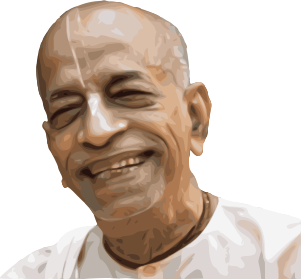
His Divine Grace A.C. Bhaktivedanta Swami Prabhupada
For decades, the path before Srila Prabhupada seemed almost impossible. After receiving the instruction to preach in the English-speaking world, he did not have an organization, wealth, or influential supporters to make it happen. He worked largely alone. He traveled through India trying to publish and distribute his books, often receiving only small orders. When sales slowed, even printing the next volume of Srimad-Bhagavatam became financially difficult. Yet he continued translating, writing, printing, and personally carrying his books from place to place.
In Delhi and Bombay, Srila Prabhupada would walk from institution to institution, approaching schools, libraries, booksellers, and influential people. There were days when his efforts produced very little. Those who knew him recalled seeing him return exhausted and discouraged, only to sit down again and resume writing. At one point, while trying to meet Sumati Morarji of the Scindia Steam Navigation Company, he sat outside her office for nearly five hours, patiently waiting for an opportunity to speak with her. He was not seeking comfort for himself; he was seeking a way to carry his spiritual master's message beyond India.
Even securing permission to leave India became a struggle. His American sponsorship was only for a limited period, and government procedures threatened to prevent his journey. Sumati Morarji herself worried that he was too old and not healthy enough to undertake such a dangerous mission. Her secretaries feared that he might not survive the journey. But Srila Prabhupada remained determined. Finally, after repeated efforts, the necessary permissions were obtained, and Scindia Steam Navigation Company agreed to give him passage to America.
On August 13, 1965, at the age of sixty-nine, Srila Prabhupada boarded the cargo ship Jaladuta at Calcutta. He was not accompanied by a large organization or a team of disciples. He carried only a small amount of personal belongings, including an umbrella and some dry cereal, while his precious cargo consisted primarily of his books. He was sailing to a country where he knew almost no one, had no temple, no established congregation, and no certainty about where he would live or how he would support himself.
The voyage across the ocean nearly cost him his life. Srila Prabhupada suffered severe seasickness, followed by two heart attacks during the journey. For an elderly man traveling alone across the ocean, death was a very real possibility. In his diary, he recorded the terrible crisis and later described how, in the midst of his suffering, he experienced a vision of Lord Krishna appearing to protect him and guide the ship toward America. After surviving the ordeal, he continued his journey. The ship eventually reached Boston after thirty-five days at sea.
On September 17, 1965, Srila Prabhupada stood in Boston Harbor. He had crossed the world, but the greatest struggle was only beginning. America was wealthy, modern, and completely unfamiliar to him. He was nearly seventy years old, had very little money, spoke with an Indian accent, and had no established followers waiting for him. He later described himself as an insignificant beggar who had come only with faith in the holy name of Krishna and the order of his spiritual master.
His first months in America were painfully uncertain. He stayed with the family of his sponsor in Butler, Pennsylvania, and later traveled to New York. There was no grand temple waiting for him. There were no crowds, no disciples, and no institution behind him. He simply continued speaking, cooking, translating, writing, and trying to introduce people to Krishna consciousness. The International Society for Krishna Consciousness did not yet exist; there was only an elderly swami trying to fulfill an instruction that had been given to him more than forty years earlier.
In New York, Srila Prabhupada eventually lived in the Bowery, an area notorious for poverty, homelessness, alcoholism, and crime. His belongings were stolen from his room, including his typewriter and tape recorder. Yet even after losing possessions that were extremely valuable to him, he continued his work. He held morning classes, cooked for visitors, translated Sanskrit texts, and led kirtanas. People would sometimes have to step over homeless men sleeping near the entrance simply to reach the room where he was teaching.
He then moved into a small storefront at 26 Second Avenue in the Lower East Side, surrounded by the counterculture of 1960s New York. Many of the young people who came to him were struggling with drugs, confusion, loneliness, and dissatisfaction with modern life. Rather than turning them away, Srila Prabhupada welcomed them. He patiently taught them how to chant, how to cook prasadam, how to read Bhagavad-gita, and how to live a life centered on devotion to Krishna.
There were no guarantees that anyone would listen. He had crossed an ocean after surviving heart attacks, entered an unfamiliar country almost alone, endured poverty and theft, and begun preaching in one of the most turbulent environments in America. Still, he went out to Tompkins Square Park and chanted beneath a tree. Day after day, he returned to the same mission. Gradually, a few young people stopped to listen. Then they began chanting. Then they began following him.
What began with one elderly man sitting beneath a tree eventually became a worldwide movement. But behind the temples, books, festivals, and thousands of disciples was a much quieter story: an old man who repeatedly faced uncertainty and hardship, yet never abandoned the instruction he had received from his spiritual master. He had no assurance of success when he left India. He had only faith, his books, and the determination to carry the message of Krishna to those who had never heard it.
Perhaps this is why the story of Srila Prabhupada's journey is more than the story of an institution. It is the story of sacrifice. At an age when most people would seek comfort and security, he crossed the world alone. When his body failed him, he continued. When money was scarce, he continued. When people rejected him, he continued. When his belongings were stolen, he continued. And when almost nobody knew his name, he continued speaking the name of Krishna.
Years later, the world would know him as the Founder-Acarya of ISKCON. But in the beginning, before the temples, before the thousands of disciples, and before the Hare Krishna movement spread across the world, there was simply Srila Prabhupada: an elderly sannyasi, sitting with his books, depending completely upon Krishna, carrying in his heart the instruction of his spiritual master.
Srila Prabhupada Chronology
- 1954: Left family, entered vanaprastha
- 1956: Resided in Vrindavan, Vamsi Gopal temple
- 1959: Began translating Srimad Bhagavatam in Delhi
- July 1959: Moved upstairs to Radha-Damodara temple
- Sept. 17, 1959: Took sannyasa, renounced order of life
- 1960 Fall: Published Easy Journey to Other Planets
- 1962 July: Moved to downstairs rooms at Radha-Damodara
- 1962-1964: Published Volumes 1-3 Srimad Bhagavatam
- 1965 Aug 13: Departed Calcutta on Jaladuta for America
- 1967-1972: Returned to Radha-Damodara, delivered lectures
- 1977: Entered eternal lila of Radha & Krishna in Goloka Vrindavan
(from: Mahanidhi Swami: Prabhupada in Radha-Damodara, BBT 2003)